
Knowledge Graph Optimization for GEO
Why Knowledge Graphs Matter for AI Visibility
As AI-powered search continues to evolve, visibility is no longer driven solely by keywords, backlinks, and rankings.
Modern AI systems such as ChatGPT, Gemini, Claude, Perplexity, and Google AI Overviews increasingly rely on entities and relationships to understand the world.
This is where Knowledge Graphs become important.
A Knowledge Graph helps AI systems understand who a company is, what it does, how it relates to specific topics, and why it should be associated with particular industries or services.
For organizations investing in GEO, optimizing for Knowledge Graphs is becoming a critical component of long-term AI visibility.
What Is a Knowledge Graph?
A Knowledge Graph is a structured collection of entities and the relationships between them.
Examples of entities include:
- Companies
- People
- Products
- Services
- Locations
- Technologies
- Brands
Rather than viewing content as individual pages, AI systems use Knowledge Graphs to understand connections.
For example:
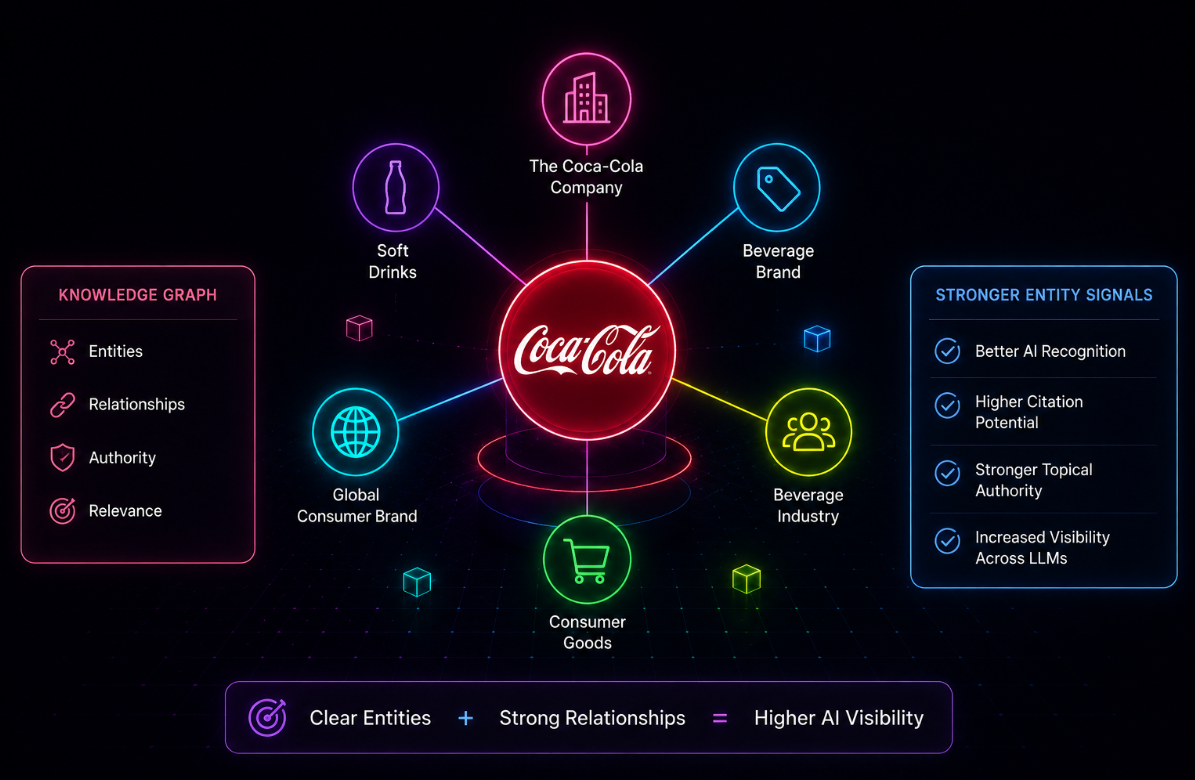
- Coca-Cola → Soft Drinks
- Coca-Cola → Beverage Brand
- Coca-Cola → The Coca-Cola Company
- Coca-Cola → Global Consumer Brand
- Soft Drinks → Beverage Industry
- Beverage Industry → Consumer Goods
When a user asks an AI system about leading beverage brands, iconic consumer products, or global soft drink companies, Coca-Cola is likely to appear because these relationships are well established across the web.
The stronger and more consistent these entity relationships become, the easier it is for AI systems to understand and recommend a brand.
Why Knowledge Graphs Influence AI Answers
When users ask questions, AI systems don't simply retrieve matching keywords.
Instead, they evaluate entities and relationships.
For example:
"What are the most recognized soft drink brands in the world?"
An AI system may identify entities such as:
- Coca-Cola
- Pepsi
- Soft Drinks
- Beverage Industry
- Global Brands
Because Coca-Cola has strong entity associations across millions of documents, news articles, company profiles, and websites, AI systems can confidently connect the brand to those concepts.
Brands with stronger entity relationships often appear more frequently in recommendations and citations.
Signs Your Brand Has Weak Entity Recognition
Many organizations struggle with AI visibility because their entity footprint is incomplete.
Common signs include:
- Inconsistent company descriptions
- Limited mentions outside the company website
- Weak author profiles
- Missing structured data
- Few references from trusted industry sources
- Poor association with target topics
When these signals are missing, AI systems may struggle to understand what your company represents.
The Five Pillars of Knowledge Graph Optimization
1. Consistent Brand Identity
Your company description should remain consistent across:
- Website pages
- Social profiles
- Directories
- Industry publications
- Author bios
Consistency helps reinforce entity recognition.
2. Structured Data Implementation
Structured data helps search engines and AI systems understand:
- Organization details
- Products
- Services
- Authors
- FAQs
- Articles
Schema markup remains one of the most effective methods for strengthening entity signals.
3. Author Authority
AI systems increasingly evaluate expertise through individuals.
Organizations should build:
- Detailed author profiles
- Expert bios
- Industry contributions
- Speaking engagements
Author authority often strengthens company authority.
4. Topical Clustering
Entities become stronger when associated with clearly defined topics.
Instead of publishing unrelated content, organizations should build clusters around strategic themes.
For example:
- GEO
- AI Visibility
- AI Citations
- LLM Optimization
- AI Brand Authority
Strong topical clustering reinforces Knowledge Graph associations.
5. External Validation
AI systems trust entities that are referenced by other trusted entities.
Examples include:
- Media coverage
- Industry reports
- Conference participation
- Partner websites
- Expert interviews
These external signals help validate your brand's position within a topic.
How Knowledge Graph Optimization Supports GEO
Knowledge Graph optimization strengthens several GEO objectives:
- Better entity recognition
- Improved citation potential
- Stronger topical authority
- Increased recommendation rates
- More consistent AI visibility
Organizations focused on long-term growth often combine Knowledge Graph optimization with ongoing visibility monitoring using an AI Brand Visibility Platform.
Common Knowledge Graph Mistakes
Focusing Only on Content
Content matters, but content alone rarely creates strong entity recognition.
Ignoring Structured Data
Without structured signals, AI systems receive less context about your brand.
Weak Author Presence
Companies that hide expertise behind generic brand messaging often miss authority opportunities.
Inconsistent Positioning
Different descriptions across platforms can weaken entity understanding.
Lack of Industry References
AI systems rely heavily on external validation when evaluating trust and authority.
Measuring Knowledge Graph Strength
While no single metric measures entity authority, organizations can monitor:
- Brand mentions
- Citation frequency
- Recommendation rates
- Share of Voice
- Topic associations
- Cross-LLM visibility
For organizations measuring AI visibility performance, our guide on measuring AI visibility ROI explains how to track visibility improvements over time.
Organizations looking to strengthen entity authority should also understand why competitors get cited more often than your brand, as entity recognition is often a major factor behind citation gaps.
Final Thoughts
Knowledge Graphs are becoming a foundational layer of GEO.
As AI systems shift from keywords toward entities and relationships, brands that invest in structured authority signals will be better positioned to earn citations, recommendations, and visibility across AI-generated answers.
The future of GEO will not be won by content alone.
It will be won by brands that become recognized entities within the topics that matter most to their audience.
Frequently AskedQuestions
What is a Knowledge Graph?+
A Knowledge Graph is a network of entities and relationships that helps AI systems understand brands, people, products, and topics.
Why is Knowledge Graph optimization important for GEO?+
It strengthens entity recognition, making brands easier for AI systems to understand, recommend, and cite.
Does structured data help Knowledge Graph optimization?+
Yes. Schema markup provides clear signals about organizations, products, authors, and content.
Can Knowledge Graph optimization improve AI citations?+
Yes. Stronger entity signals often lead to higher visibility, recommendations, and citations across AI platforms.
Written by
Eyal Fadlon
CGO @42A