
One of the most frequent executive questions today is simple:
“How do we measure ROI from AI visibility?”
It’s a fair question - and a difficult one.
Traditional SEO ROI is built on deterministic metrics:
- Organic traffic growth
- Keyword rankings
- Conversions
- Assisted revenue
AI visibility introduces a different paradigm.
LLMs influence decisions before clicks happen.
That means ROI modeling must evolve from click attribution to influence attribution.
And that requires a deeper framework.
1. The Structural Attribution Problem
In traditional SEO, ranking leads to traffic. Traffic leads to conversions. Conversion data can be attributed.
In AI ecosystems:
- A buyer asks an LLM for recommendations.
- Your brand appears first.
- The buyer later Googles your brand directly.
- Direct traffic increases.
- SEO dashboard shows no ranking change.
What actually drove influence?
AI visibility did.
This creates a hidden attribution layer.
We must model ROI beyond last-click.
2. Probabilistic Inclusion as a Revenue Lever
LLMs do not rank pages.
They assign probabilistic inclusion based on semantic embedding strength.
Inclusion probability depends on:
- Entity reinforcement
- Co-mention architecture
- Topical authority depth
- Contextual repetition
- Competitive displacement balance
Inclusion Modeling Table
| Variable | SEO Equivalent | AI Visibility Impact |
|---|---|---|
| Topical Authority | Content depth | Inclusion probability |
| Co-Citation | Backlinks | Association strength |
| Entity Signals | Structured data | Knowledge graph embedding |
| Comparative Mentions | SERP overlap | Displacement resistance |
Teams monitoring these signals through an advanced AI Brand Visibility Platform gain measurable insight into inclusion volatility across high-intent prompts.
Without structured inclusion modeling, ROI remains invisible.
3. Weighted Position = Influence Multiplier
In AI answers, position carries cognitive dominance.
A brand consistently appearing first in enterprise prompts holds disproportionate authority influence.
Position Weight Model
| Position | Perception Multiplier |
|---|---|
| 1st | 1.0 |
| 2nd | 0.65 |
| 3rd | 0.35 |
| 4+ | 0.15 |
This mirrors SERP CTR curves - but inside LLM outputs.
Small positional shifts can create nonlinear ROI impact.
4. Buyer-Stage Prompt Coverage
Not all prompts are equal.
Inclusion in informational prompts has limited ROI.
Inclusion in buyer-stage prompts is revenue-proximate.
Prompt Funnel Model
| Prompt Type | Revenue Influence |
|---|---|
| Informational | Low |
| Comparative | Medium |
| Enterprise Evaluation | High |
| Strategic Vendor Selection | Very High |
For example:
“Best AI visibility tools”
vs
“Best enterprise AI brand monitoring platform for SaaS”
The second is closer to revenue.
Structured AI brand recommendation analysis across buyer-stage prompts allows precise ROI modeling.
5. Displacement & Revenue Leakage
If a competitor replaces your brand in high-intent prompts, revenue influence shifts.
Displacement Risk Matrix
| Scenario | Revenue Impact |
|---|---|
| Same competitor replaces consistently | High leakage |
| Rotating competitors | Moderate risk |
| Fragmented presence | Opportunity |
This mirrors traditional SEO share-of-voice models - but applied at the LLM layer.
6. Cross-LLM Stability & Market Control
If visibility is high in ChatGPT but weak in Gemini, authority is fragmented.
Fragmented authority reduces cumulative ROI.
Cross-Model Stability Index
| Stability Score | Market Interpretation |
|---|---|
| 80–100% | Structural dominance |
| 60–79% | Competitive tension |
| 40–59% | Volatility |
| <40% | Weak embedding |
Cross-LLM stability directly correlates with market trust.
7. Executive Translation Layer
Executives don’t want prompt logs.
They want:
- Composite AI Visibility Score
- Enterprise Prompt Inclusion %
- Competitive Displacement Rate
- Weighted Authority Index
AI visibility ROI must be translated into board-level metrics.
Executive-Level AI Visibility Benchmarking in Practice
Executives require clarity, not prompt-level complexity.
The dashboard below illustrates how AI visibility performance can be translated into structured, portfolio-level intelligence - including comparative visibility scores and momentum tracking across competitive sets.
This executive view, powered by the 42A AI Visibility Platform, converts probabilistic inclusion modeling into measurable market influence indicators.
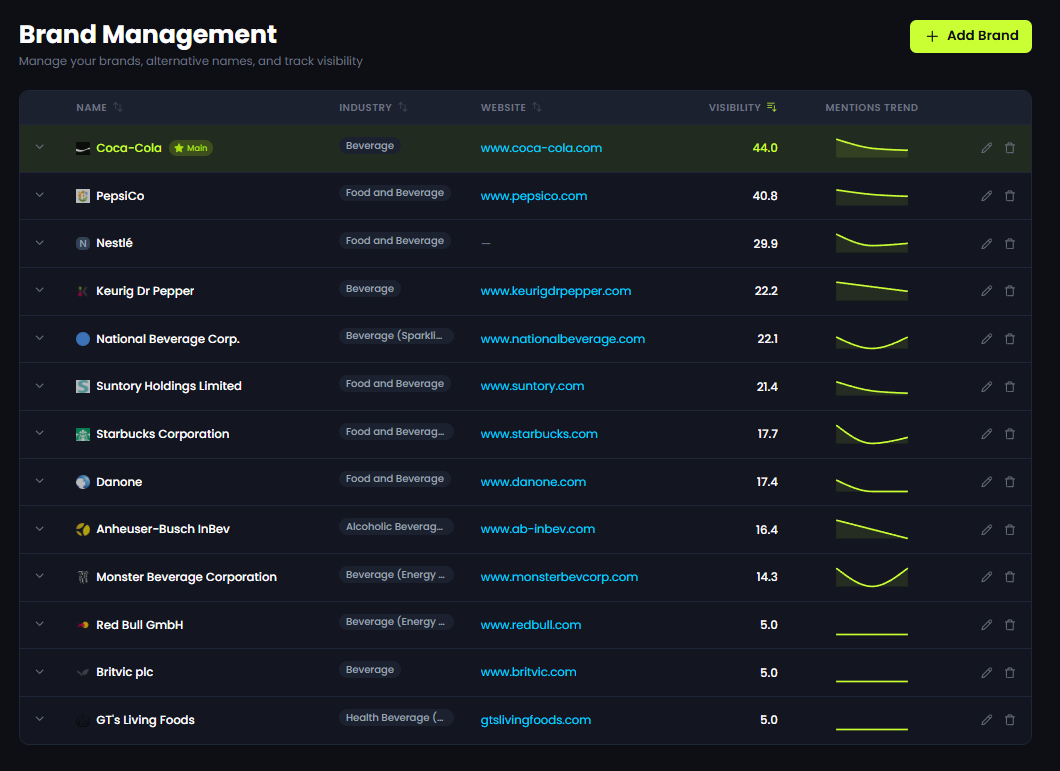
Multi-brand AI visibility benchmarking with structured visibility scoring and trend monitoring.
Generated within the 42A AI Visibility Platform.
When AI visibility is measured as a composite score with competitive benchmarking and trend analysis, organizations can correlate authority stability with pipeline performance and market share shifts.
Without executive-level dashboards, AI visibility remains operational data - not strategic intelligence.
8. Human Insight
AI visibility compounds.
Just as domain authority compounds in SEO, narrative embedding compounds in LLM ecosystems.
Brands that reinforce:
- Topical clusters
- Entity clarity
- Comparative authority
- Co-mention strength
Build long-term inclusion stability.
AI visibility ROI is not instant. It is cumulative authority leverage.
Strategic Conclusion
AI visibility ROI must be measured as influence modeling, not traffic modeling.
Organizations that structure:
- Inclusion tracking
- Position weighting
- Buyer-stage mapping
- Displacement benchmarking
Will understand ROI before competitors even realize influence has shifted.
AI visibility is not vanity exposure.
It is structured probabilistic market influence.
Written by
Eyal Fadlon
Growth marketing specialist