
In AI-driven discovery environments, visibility is no longer governed by page rank - it is governed by probabilistic inclusion inside generated answers.
Large language models do not rank URLs. They synthesize knowledge. Therefore, measuring AI positioning requires a fundamentally different framework from traditional SEO analytics.
AI positioning must be quantified across five primary dimensions:
- Inclusion frequency
- Weighted answer position
- Sentiment and narrative framing
- Competitive displacement
- Cross-LLM stability
Without structured metrics, AI optimization becomes speculative. With structured measurement, visibility becomes controllable.
1. Inclusion Rate (Mention Frequency)
Inclusion rate measures how often your brand appears across a structured library of tracked prompts.
Unlike impressions in traditional SEO, AI inclusion reflects contextual authority. If a model repeatedly includes your brand in high-intent evaluation prompts, it indicates strong knowledge embedding.
Inclusion Tracking Framework
| Metric | Definition | Strategic Meaning |
|---|---|---|
| Prompt Coverage % | % of tracked prompts with inclusion | Category authority breadth |
| High-Intent Coverage | % of buyer-stage prompts | Revenue proximity |
| Inclusion Trend | Month-over-month change | Narrative growth trajectory |
Enterprise teams typically centralize these metrics inside an advanced AI Brand Visibility Platform, where inclusion trends are analyzed across models and intent clusters.
Inclusion consistency is more important than isolated dominance.
2. Weighted Position Index
AI systems often present recommendations in ordered formats - explicitly or implicitly.
Being mentioned first carries significantly more cognitive weight than being mentioned third.
Position Weight Model
| Position in Answer | Authority Weight |
|---|---|
| 1st Mention | ~45% perception dominance |
| 2nd Mention | ~30% |
| 3rd Mention | ~15% |
| 4+ | Minimal impact |
Weighted Position Index = Inclusion Frequency × Positional Weight
This index provides a more accurate measure of visibility strength than inclusion alone.
3. Sentiment & Narrative Framing
LLMs attach descriptors to brands, influencing perception bias.
Examples include:
- “Leading enterprise solution”
- “Emerging platform”
- “Affordable alternative”
- “Specialized tool”
Framing Impact Table
| Descriptor Type | Visibility Impact |
|---|---|
| Leading / Market Leader | High trust |
| Enterprise-Grade | B2B validation |
| Emerging | Growth-stage signal |
| Neutral listing | Low persuasive power |
Tracking sentiment distribution enables structured narrative reinforcement strategies.
4. Competitive Displacement Index
Replacement risk measures which competitor appears when your brand is absent.
Displacement Analysis
| Scenario | Strategic Risk |
|---|---|
| Single dominant replacement | High |
| Rotational competitors | Medium |
| Fragmented category | Opportunity |
Consistent displacement signals authority asymmetry.
Monitoring this dynamic requires structured AI Competitive Intelligence, especially across high-value enterprise prompt clusters.
5. Cross-LLM Stability Score
AI visibility must be evaluated across multiple models:
- ChatGPT
- Gemini
- Claude
- Perplexity
Cross-Model Comparison
| Model | Inclusion Rate | Avg Position | Stability |
|---|---|---|---|
| ChatGPT | High | 1–2 | Stable |
| Gemini | Medium | 2–3 | Variable |
| Claude | High | 1 | Strong |
| Perplexity | Low | 3+ | Weak |
True authority means stable positioning across ecosystems.
Real-World Example: Cross-LLM Stability in Action
The following snapshot demonstrates how core AI visibility metrics translate into measurable brand positioning.
Using 10 high-intent prompts analyzed through the 42A platform, the system evaluates structured inclusion metrics rather than traditional ranking signals.
Key outputs include:
- 100% Prompt Coverage
- 30 Total Mentions
- 50% First Position Appearance
- 90% Top 3 Inclusion
- Cross-LLM Measurement (ChatGPT + Gemini)
These metrics form the foundation of a quantified AI Visibility Score — enabling brands to move from assumption to measurable authority modeling.
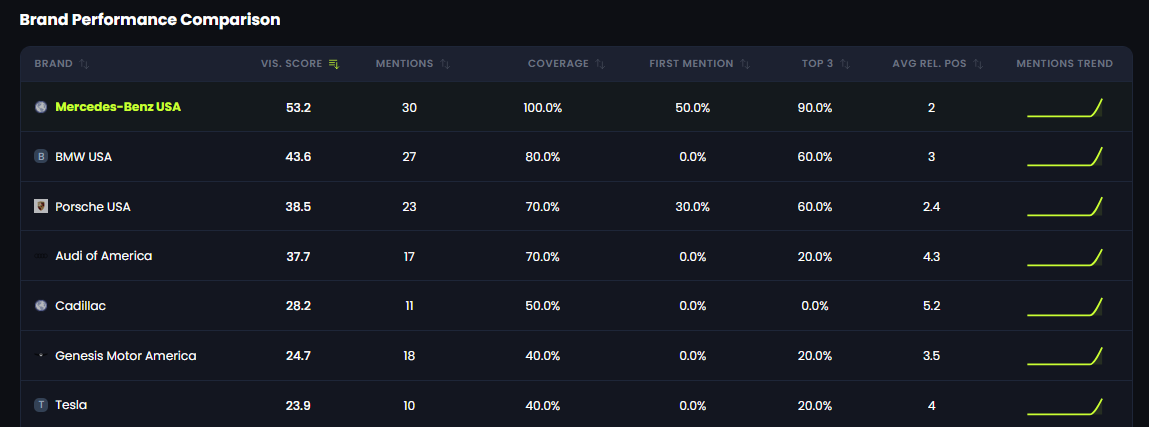
Example of structured AI visibility scoring within the 42A platform — transforming prompt inclusion into measurable positioning metrics.
Strategic Conclusion
AI positioning is measurable.
Organizations that operationalize:
- Structured inclusion metrics
- Weighted position scoring
- Narrative stability analysis
- Competitive displacement tracking
Gain strategic control over probabilistic visibility.
AI visibility is no longer experimental - it is an executive KPI.
Written by
Eyal Fadlon
Growth marketing specialist